With the ability to form an LLC or corporation online, open accounts digitally, manage operations right from your laptop, and run your company from anywhere in the world, starting a business has never been easier. For many, that flexibility is exactly what makes remote business ownership so appealing.
Still, there’s one part of the setup process that causes more problems than most business owners expect: choosing the right business address.
If you’re looking to learn why your business address is so important, which types of addresses support verification and how you can build your compliance-ready business address setup from the start, you’re in the right place.
California business address requirements explained
When forming a California LLC or corporation, you'll need more than just a simple mailing address. California requires businesses to provide a physical business address and designate an Agent for Service of Process (i.e. a registered agent) with a physical California street address.
For most businesses, this means maintaining:
- A principal business address (this must be a physical street address)
- A mailing address (may be separate from the business address)
- An Agent for Service of Process address (this also needs to be a physical California address so that legal documents can be delivered)
Meeting California filing requirements is only part of the equation, however. Banks, payment processors, marketplaces, and other institutions may separately verify your address and request additional documentation to confirm your connection to the location. This is why many businesses look beyond basic mail-receiving solutions and seek address setups that can also support verification and compliance requirements.
Why your business address matters more than ever
Remote business ownership has exploded over the past several years, and verification systems have evolved right alongside it.
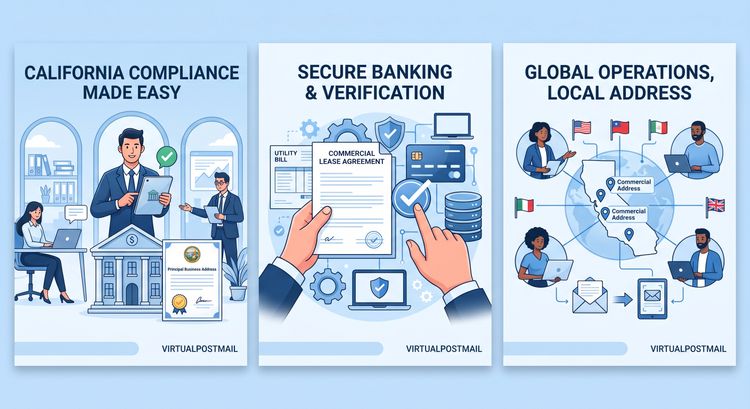
Banks are required to follow KYC (Know Your Customer) and CIP (Customer Identification Program) regulations when onboarding business customers. These rules require financial institutions to verify not only who owns a business, but also where the business is physically located. That's why banks often ask for documents such as lease agreements, utility bills, or other records that tie a business to a real address.
Today, your business address may influence:
- Whether a bank account gets approved
- How quickly applications move through compliance review
- Whether payment processors request additional documentation
- How your business is categorized in automated systems
- Whether marketplaces flag your account for additional review
For many remote businesses, address verification has quietly become one of the biggest problems behind the scenes.
The challenge is that many entrepreneurs don’t learn about these issues until they’re already dealing with delays or denials. By then, fixing the problem often means updating formation documents, changing account information, and resubmitting applications across multiple platforms.
Building a stronger address setup from the beginning is usually much easier and far less disruptive.
The limitations of virtual mailboxes, PO boxes, and virtual offices
Virtual mailboxes have become incredibly popular with remote businesses, digital nomads, ecommerce sellers, and startups because they solve a real issue: mail management. They allow you to receive business mail remotely, view scanned documents online, forward packages from anywhere, and avoid using your home address publicly. For mailing address needs only and day-to-day convenience, virtual mailboxes are an excellent business solution.
Similarly, PO boxes and virtual offices can provide an alternative mailing address with a professional-looking front. However, many entrepreneurs mistakenly assume these solutions can satisfy every business verification requirement.
They can’t, and here is why:
Most virtual address services were designed for mail handling. Opening a business bank account, applying for payment processing, registering with marketplaces, and obtaining business licenses requires documentation that proves your connection to a physical operating location.
In many cases, compliance teams want to see supporting records such as:
- A signed commercial lease agreement
- A utility bill tied to that specific address
Most virtual mailbox services, PO boxes, and virtual office providers simply don't provide these documents because that's not what they were built for. As a result, business owners are often surprised to discover that an address that works perfectly well for receiving mail may not satisfy every verification requirement. Understanding why starts with understanding how many of these addresses are classified.
What is a CMRA and why do banks reject them?
One of the most common reasons virtual addresses get flagged is because they are classified as CMRAs, or Commercial Mail Receiving Agencies. A CMRA is a business that receives mail on behalf of customers, such as mailbox rental stores and many virtual mailbox providers.
From a mail handling perspective, there’s nothing inherently wrong with a CMRA. In fact, they’re extremely useful for remote businesses that need flexible mail access. However, many banks, marketplaces, and automated verification systems can identify these addresses through USPS databases and third-party compliance tools.
Once an address is recognized as a mailbox-style location instead of a true commercial office, businesses often face additional scrutiny. That can trigger manual reviews, requests for supporting documentation (i.e. a lease agreement or utility bill), or outright application denials depending on the institution’s policies.
Comparing California business address options
With more address options available to businesses today than ever before, finding one that works for you can be overwhelming. Some are designed primarily for affordability, while others focus on convenience or workspace access. Very few are specifically built to support verification and compliance requirements. Here’s how the most common California business address options compare.
|
|
|
|
|---|---|---|
| PO Box |
|
|
| Virtual Mailbox |
|
|
| Virtual Office |
|
|
| Coworking Space |
|
|
| Physical Office Lease |
|
|
| TruLease |
|
|
For many remote businesses, leasing a full physical office simply isn’t practical or necessary. At the same time, relying solely on a standard virtual mailbox can create avoidable compliance headaches.
That’s why solutions like TruLease are becoming increasingly valuable for businesses that want the flexibility of remote operations without sacrificing verification readiness.
How to meet California business address requirements
When businesses consistently pass verification checks, there’s usually one major factor working in their favor: they can provide documentation that proves a legitimate commercial business presence.
In most cases, that means having access to supporting documents such as:
- A signed commercial lease in the business name
- A utility bill connected to the address
- A legitimate commercial office location
- Business records tied directly to the address
This is exactly what TruLease was designed to provide.
Rather than functioning as a standard mailbox rental service, TruLease focuses specifically on helping businesses establish a stronger verification foundation without requiring the expense of leasing a traditional office full-time.
With the service, businesses receive a commercial lease in their business’s name, a utility bill tied to the address, and of course, a real commercial business location.
What makes TruLease different from a standard virtual mailbox
Most virtual mailbox providers are built around convenience–which is great, if that's what your business needs. TruLease, however, is built around compliance and verification readiness.
One of the biggest differentiators is how the address itself is classified. Many virtual mailbox providers operate from locations that are identified as mailbox centers or CMRAs, which can increase the likelihood of verification issues. TruLease addresses, on the other hand, are structured as legitimate commercial office suites designed to support business verification needs.
That distinction matters because it gives businesses access to the types of documentation banks and marketplaces commonly request during compliance reviews.
Instead of trying to explain why your address belongs to a mailbox rental store, TruLease provides you with documentation–a commercial lease and associated utility bill–that aligns with what verification teams already expect to see from established businesses.
For ecommerce sellers, remote startups, consultants, agencies, and online businesses, this can significantly reduce the amount of back-and-forth during onboarding and compliance reviews.
Don’t replace your virtual mailbox, strengthen it
A virtual mailbox still provides excellent value for remote businesses. It allows you to receive mail digitally, access scanned documents online, forward packages from anywhere, deposit checks remotely, and manage sensitive mail securely without being tied to a physical office.
With VPM, businesses can manage mail through an online dashboard and access important documents anytime, from anywhere in the world. This is one of the biggest reasons virtual mailboxes remain so popular among remote teams and online businesses.
The difference is that TruLease strengthens the verification side of the equation.
By pairing a virtual mailbox with a verification-ready commercial lease setup, businesses can maintain the convenience of digital mail management while also having stronger supporting documentation available for banks, marketplaces, and compliance reviews.
Businesses also benefit from additional services that simplify compliance management even further. For example, all California plans include FREE registered agent service, helping businesses maintain compliance requirements while centralizing mail and legal correspondence in one place.
Ready to build a California business address that works on every front?
A strong address setup should support both sides of modern business operations. It should make day-to-day mail management easy while also holding up during verification checks and compliance reviews. When businesses rely on address solutions that only solve one side of the problem, they often end up dealing with avoidable delays, denials, and administrative headaches later.
That’s why many remote businesses are moving toward a smarter hybrid approach. By using a virtual mailbox for daily operations and pairing it with TruLease for compliance and verification support, businesses can maintain flexibility without sacrificing credibility.
If you’re building a remote business in California, getting your address setup right from the beginning can save significant time and frustration down the road.
Explore VPM’s TruLease California plans and create a business address setup designed to support both convenience and compliance.