Delaware is home to more than 2 million business entities. From global companies like Amazon, CVS Health, and Alphabet to fast-growing startups and small businesses, organizations of every size continue to incorporate in the First State.
For years, many business owners used their registered agent address for more than receiving legal notices. Since every Delaware corporation and LLC is required to appoint a registered agent, it became common to list that address as the company's primary business address as well.
Today, that approach can create problems. Delaware Senate Bill 273 reinforced that a registered agent address and a company's principal place of business serve different purposes.
While the law focuses on corporate reporting, it reflects a broader trend. Banks, government agencies, payment processors, and other institutions are placing greater emphasis on verifying where businesses actually operate, making a real, verifiable business address more important than ever.
In this article, we'll explain what changed under SB 273, why it matters, and how to choose an address strategy that supports both Delaware compliance and today's verification requirements.
What changed? Understanding Delaware Senate Bill 273
Historically, many companies have blurred the distinction between their registered agent address and their actual business address. Since a registered agent was already required, it often became the default address used across filings, accounts, and business registrations.
Delaware Senate Bill 273 clarified that these two addresses serve different purposes.
Effective as of 2023, the law formally separated the role of a registered agent from a company’s principal place of business, reinforcing that the registered agent is only meant for legal and official correspondence, not day-to-day business operations.
Why Delaware passed the law
The change was driven by a need for clearer, more accurate business records. When the same address was used for both legal and operational purposes, it created confusion for regulators, financial institutions, and anyone trying to verify where a business actually operates.
By requiring a distinct principal place of business, Delaware improved transparency in corporate filings and aligned its rules with broader verification standards used by banks, payment processors, and government agencies.
For example, SAM.gov explicitly rejects registered agent addresses, virtual addresses, and mail forwarding addresses when it requires a physical operating location. Banks and fintech providers have also tightened KYC and business verification requirements, often requesting evidence that the business actually operates from or has a legitimate connection to the address provided.
Although it may feel like an added inconvenience for business owners, it ultimately works in their favor by establishing a clear principal place of business that unlocks more opportunities and stronger credibility for the company.
Principal place of business vs. registered agent address
Understanding the difference between these two addresses is key to staying compliant and avoiding verification issues. While they both appear in corporate filings, they serve very different roles and are used for different purposes by banks, regulators, and state agencies.
What is a registered agent address?
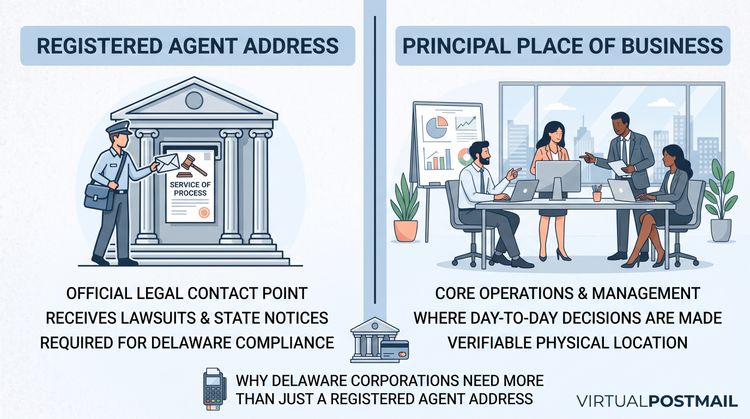
A registered agent address is the official mailing address of a designated third party responsible for receiving legal documents on behalf of a company. This includes things like service of process, state notices, and compliance-related correspondence.
It is not intended to represent where a business operates, where employees work, or where management decisions are made. Instead, it functions as a legal contact point that ensures important documents are received and handled properly.
What is a principal place of business?
A principal place of business is the physical location where a company’s core operations and management actually take place. This is where decisions are made, business activities are directed, and day-to-day operations are carried out.
Unlike a registered agent address, it reflects the real-world presence of the business and is often what banks, payment processors, and government agencies use when verifying a company’s legitimacy.
Understanding the different types of business addresses
Recognizing these differences can help businesses avoid an all-too-common mistake: assuming a single address can meet every requirement.
| Registered Agent | ||
| Principal Place of Business | ||
| Mailing Address |
The new challenge for remote Delaware businesses with separate registered agent addresses
For remote-first companies, the shift toward stricter address verification can create a gap between how a business operates and how it is expected to present itself on paper. Many founders don’t maintain a traditional office, yet they still need to satisfy banks, payment processors, and state requirements that assume a physical operational location.
This often leads to confusion when a single address, such as a registered agent or mail forwarding service, no longer meets every requirement. As verification standards become more detailed, businesses are increasingly expected to separate legal, mailing, and operational addresses in a clear and consistent way.
Why a business address alone is no longer enough for verification
Today's verification standards go beyond simply checking whether your business has an address on file. Banks, payment processors, government agencies, and other institutions increasingly want evidence that your business operates from a real, physical location—not just a mailing address or registered agent's office.
That means listing an address on your formation documents or public records is often only the first step. To complete verification, businesses may also be asked to provide supporting documentation, such as a commercial lease agreement or utility bill, to confirm that the address is genuinely tied to their operations.
When address verification is required for businesses
As of 2026, address verification is now a standard step in many parts of running a business. Common situations where proof of address may be required include:
- Opening a business bank account
- Applying for merchant services
- Setting up payment processors like Stripe or PayPal
- Registering for state or local licenses
- Onboarding with marketplaces or financial platforms
In each of these situations, organizations want to verify that your business address reflects a real, true operational presence, not just a place to receive mail or satisfy a filing requirement.
Documents commonly requested during address verification
To confirm a business address, institutions typically request supporting documentation such as:
- Lease agreement
- Utility bill
- Business license
- Official government correspondence showing the address in use
These documents help establish that the address is active, occupied, and legitimately tied to the business.
Why lease agreements and utility bills matter for address verification
Lease agreements and utility bills are often considered the strongest forms of address verification because they tie a business to a real, occupied location over time. A lease shows a formal agreement to operate at a specific address, while utility bills provide ongoing proof that the location is active.
Building a Delaware address strategy that works today
Instead of relying on one address for everything, businesses can benefit from building a simple, structured approach. Each address serves a specific purpose, and together they create a setup that supports both compliance and day-to-day operations.
This typically means separating three key functions: legal compliance, mail management, and address verification. When each role is clearly defined, businesses are better prepared for banking, onboarding, and regulatory checks without delays or rejections.
Registered agent: For Delaware compliance
A registered agent address should be used strictly for legal and state-level requirements. Its primary purpose is to receive official documents such as service of process, tax notices, and compliance correspondence from the state of Delaware.
It ensures the business stays in good standing, but it is not intended to represent where the company operates or makes business decisions.
Virtual mailbox: For mail management
A virtual mailbox provides a centralized way to receive, scan, and manage business mail from anywhere. It is especially useful for remote teams and digital-first companies that need consistent access to correspondence without being tied to a physical office.
With a VPM virtual mailbox, businesses can handle mail digitally while also maintaining a professional mailing address. In addition, it includes free registered agent service to support basic compliance requirements.
TruLease: For banking, merchant accounts, and platform verification
For situations that require stronger proof of address, such as opening bank accounts, applying for merchant services, or completing platform verification, businesses often need documentation that reflects a real, verifiable physical presence.
Services like TruLease are designed to support this layer by providing lease documentation and supporting address credentials that help meet stricter verification requirements across financial institutions and online platforms.
As these requirements continue to expand across industries, more businesses are realizing that having an address on file is not enough on its own. What matters is whether that address can be backed by documentation that satisfies modern compliance and verification standards.
How TruLease helps meet banking and compliance requirements
With heightened verification standards the new norm, many companies are discovering that a basic business address is no longer enough. They need a setup that not only receives mail, but also produces the documentation required to pass compliance checks.
TruLease is designed specifically to remedy this by combining a commercial business address with supporting documentation that businesses can use for verification purposes.
The service helps businesses meet strict compliance requirements by providing:
- A commercial business address suitable for business registration and operations
- A lease agreement tied to the business name and address
- Utility bill support that helps strengthen proof of occupancy
For remote companies and international founders, this can make a big difference when working with U.S. institutions without a traditional office. By combining a real business address with the documentation needed for verification, TruLease helps simplify approvals and reduce unnecessary delays.
Frequently asked questions
Can I use my registered agent address as my business address in Delaware?
A registered agent address can be used for receiving legal notices and official state correspondence, but it is not intended to serve as your company's principal place of business.
What is the difference between a registered agent address and a principal place of business?
A registered agent address is where legal documents and service of process are delivered. A principal place of business is where a company's management and day-to-day operations are directed. They serve different purposes, and many organizations now expect businesses to distinguish between the two.
Does Delaware require a principal place of business?
Yes. Delaware businesses are expected to identify their principal place of business in their corporate records and filings where applicable. This address should reflect the location where the business is managed or operates, rather than the address of the registered agent.
Can I use a virtual mailbox as my principal place of business?
No. While a virtual mailbox is an excellent solution for receiving and managing mail remotely, it does not satisfy verification requirements. Many banks, payment processors, and government agencies require a physical operational address supported by documentation such as a commercial lease agreement or utility bill.
Why do banks ask for a lease agreement or utility bill?
Financial institutions are required to verify the legitimacy of the businesses they serve as part of Know Your Customer (KYC) and Anti-Money Laundering (AML) compliance programs. A lease agreement and utility bill help demonstrate that a business has a legitimate connection to the address it provides.
What if my business is fully remote?
Many modern businesses operate without a traditional office, but they may still need a verifiable business address for banking, licensing, merchant accounts, and platform onboarding. In these situations, businesses often use separate solutions for legal compliance, mail management, and address verification to meet different requirements.
The takeaway for Delaware corporations
SB 273 made one thing clear: a registered agent address is not the same as a company’s principal place of business. While the change started as an update to corporate recordkeeping, it reflects the change in how businesses are expected to present and verify their address information.